
Product Positioning
And the quest for awesomeness

I actually read Obviously awesome by April Dunford a few years ago but it wasn’t super actionable for me at the time. 2 years later, after starting out as a PM for B2B tech companies, I happened to randomly listen to April again on one of Lenny’s podcast episodes and my mind was blown by how much I could now relate to some of her examples and stories.
So here are my cherry-picked, non-biased, actionable insights from her latest podcast. I can only encourage you to read or listen to the source herself. She’s obviously awesome.
N.B.: Most of her insights and tactics are geared toward B2B tech companies as she admits that she hasn’t figured out B2C yet, and let’s be real here: B2C positioning is probably an esoteric art anyway.
Everything sucks a bit
What happens when your positioning is off? It’s not really metric-based as we would all love it to be, but according to April what you can say is that “everything sucks a bit”. There are a few clues you can spot here and there that can help you see this positioning issue across all stages of the pipeline:
Early-stage, prospects don’t resonate with your marketing material or don’t understand your prospecting calls
Sales messaging is not understood clearly or the product is hard to explain during the sales process.
Some people end up churning pretty quickly as they thought your product was doing something else.
One major clue she says when sitting with Sales is the following:
Initial sales call with a client, the Sales Rep is doing a great job but the customer says something like: “Back it up and do that part of the pitch again” worst the customer thinks they know exactly what you are but that is not it, you hear things like: “you are just like Salesforce” or ”I totally get what you do but I could do that in a spreadsheet, why would anyone would pay for this ?” are usually good signs that your positioning is weak.

How do we sometimes get it wrong?
Most of the time the problem often stems from internal miss-alignment :
CEO or founder has an idea of how your product is positioned and what it does
Marketing has a slightly different idea
Sales or Product has again a slightly different idea
Usually, because the company has grown quickly and the founders struggled to align everyone around how to position the product or because the market has shifted and the initial successful positioning is no longer relevant and we are not aligned anymore.
According to April, who has advised more than 200 companies on positioning, in the majority of cases, that’s what’s at play.
Hence, any repositioning effort should not be done in isolation, driven solely by Marketing or Product but include everyone including the founders, so it can stick inside the company.
What is it and how do you do positioning?
Positioning defines how your product is the best in the world delivering some unique value to a well-defined set of companies that care a lot about it.
The first step is usually sitting with Sales or Marketing and asking the question “Why people are loving our stuff ?” … and that would probably be a bad idea to do so because you will just get a bunch of opinions.
The rule of thumb here is that if you are not the buyer, you are likely not the right person to know if your positioning is great: Try landing on postman.com if you know nothing about APIs.
April’s recommendation is to actually start by thinking about “How do I have to position myself against “ and find the “competitive alternatives”- not to get confused with only the direct competition. They include the following:
Status quo, i.e. the current way of solving the problem you’re addressing
The shortlist of close competitors
“In B2B we lose about 40% of the deal to a “No decision” which let’s be real, means you lost to the spreadsheet”
You should then list the differentiating capabilities of the product, the list of features that you have and map them to values. The “so what” of each feature. That can then be segregated by 2 or 3 Values themes of your product.
By doing this you ensure that those values are differentiated and not just things that are valuable and anything and anyone can do.
You could sell to all companies that share the problem but not everyone will care in the same way about your values.
So the question now becomes: “What are the characteristics of a targeted account that make them really care a lot about these values?”
E.g. they all use the same software, or they have the same team size, etc.
This will allow you to define your best-fit customers to go after.
Finally, there is the market category, positioning then became finding the context where the value of your product is obvious to the majority of the companies in this segment
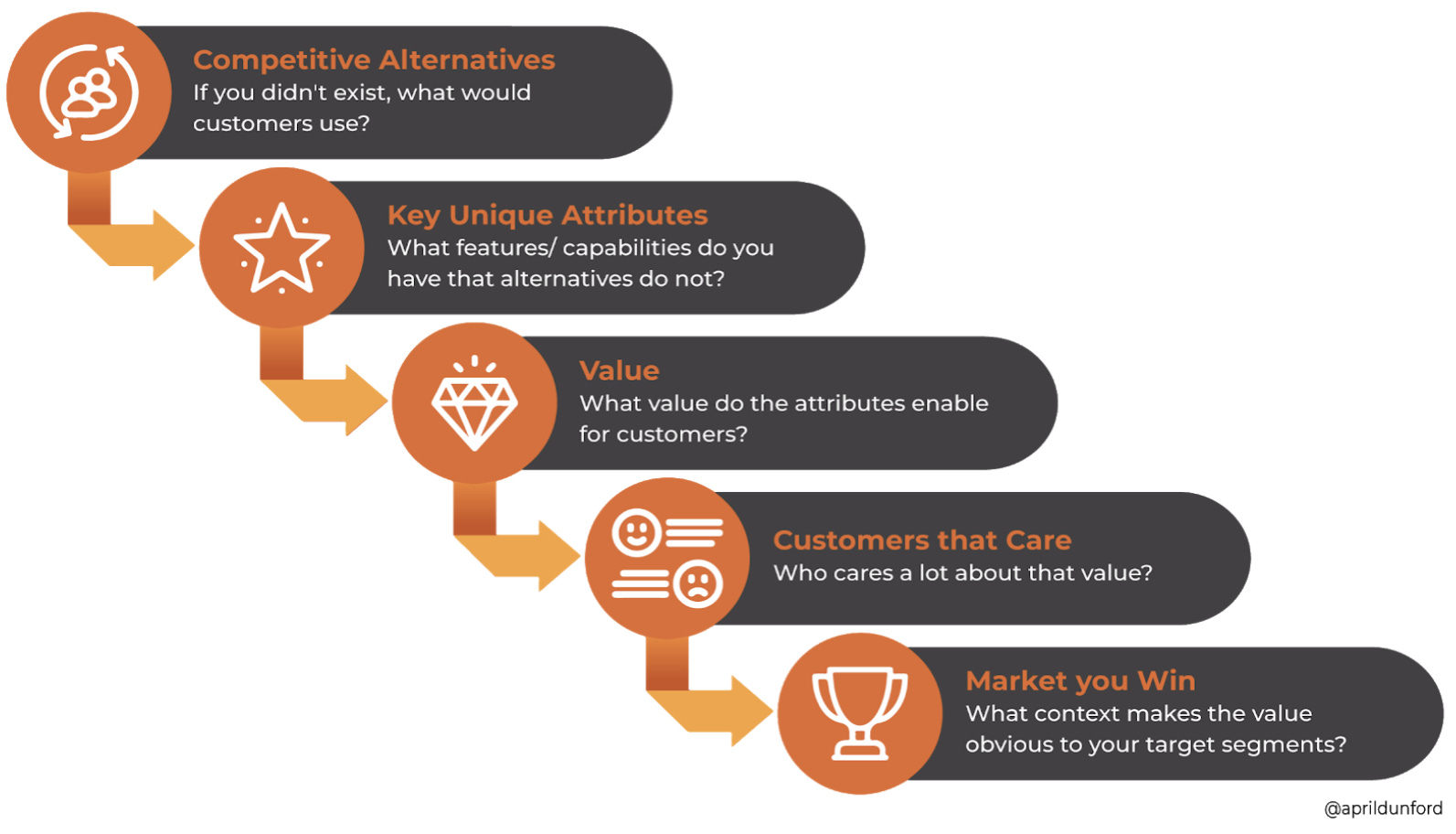
Once that’s done, and everyone is aligned you can make it actionable across all teams:
Find a new shortlist of companies to go after
New sales pitch and tactics
Make new marketing material
PM double down on those values inside of the product
When should you do positioning?
Usually beyond the seed stage or series A.
Why not earlier, you ask?
Let’s say you are a small company about to launch into a new market, what you have is a “positioning thesis”, and you might just go ahead, document it, and test it out - as you are most likely to be partially wrong anyway.
There is also merit in keeping the positioning a bit loose in the early days as explained by April’s awesome Tuna fishing net analogy:
You built a fishing net for Tuna, only for Tuna, the best fishing net in the world for Tuna.
When you market it for the first time you shouldn’t say it’s for Tuna only
After you hit the market the fishnet is actually very popular and good for another fish, let’s say Groupers
You’ll end up repositioning your fishing net for “big fish” or Groupers only once you understand the patterns.
In conclusion, it’s okay if your positioning is a bit loose in the early days and you tighten it up later on.

When to switch
When you are able to see the patterns. When you realize you are much more likely to win in a specific type of scenario, with a certain type of customer and you also know when you’re much more likely to lose.
Side note: Persona vs Segment
In B2B Software, especially enterprise, you have typically 5 to 7 people (think IT, Security, Procurement, etc) to go through before closing a deal.
Doing personas for everyone in this process is not actionable.
The goal is to position yourself to arm the Champion to go sell the deal internally to the rest of his team including the Economic Buyer, and the only way to do that is to nail your positioning on a specific segment against all other alternatives.
Meaning you know exactly the type of company the champion is in, why your product is better than the competition the value and features he cares about. You should be able to articulate why you are the best kind of solution for this particular customer.
Takeaway
Positioning is a powerful strategy tool, that if used properly can really shake up the way you bring a product to market and the overall trajectory of a company.